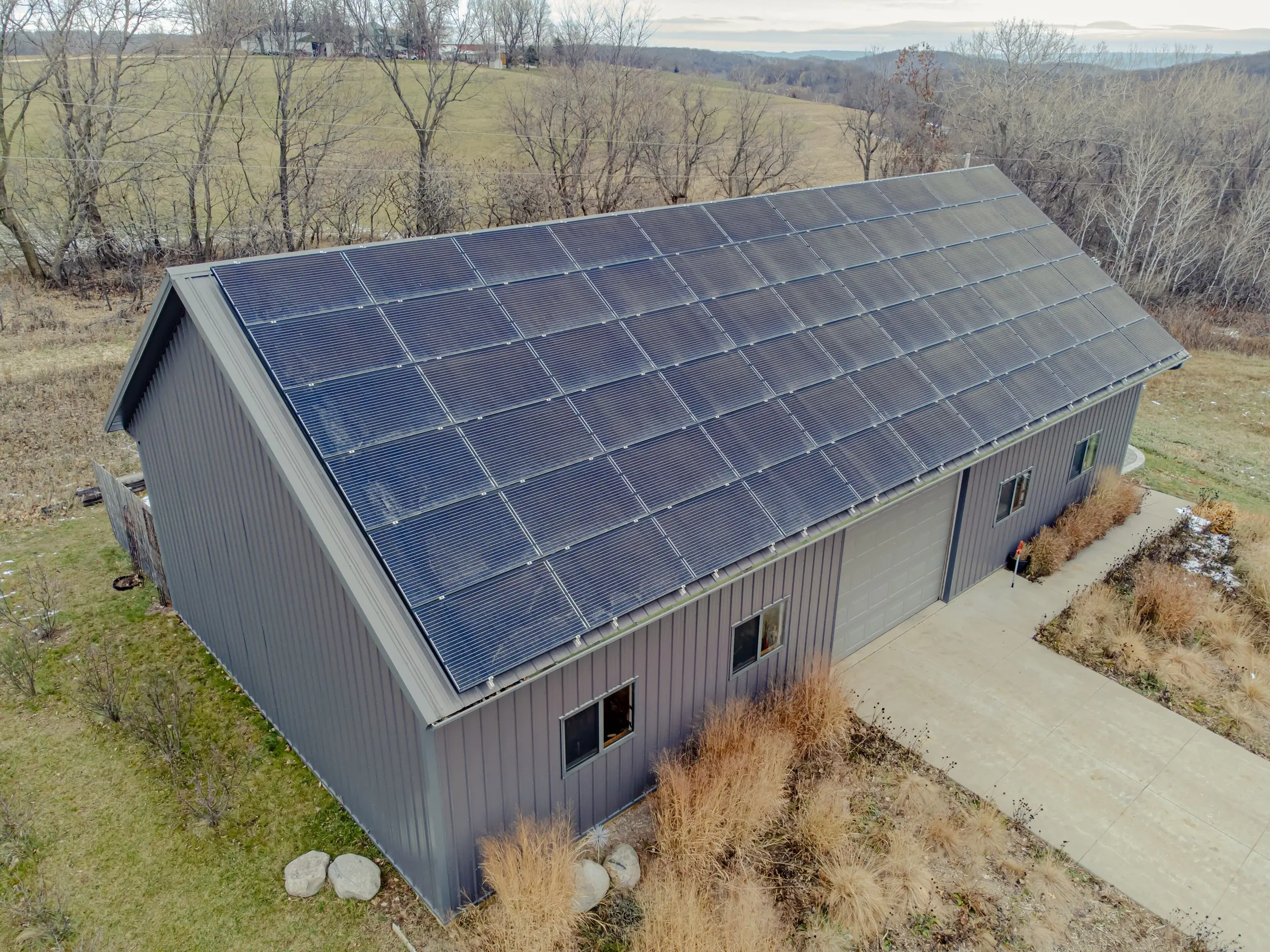
Town or County: find your permit office first
Start with one question: is your address inside Town of Bayfield limits? A Bayfield mailing address can sit on either side of the line, and the permit office, code edition and design values all change there.
Inside town limits, the Town Building Division permits all construction, and no work may start before the permit is issued. Its Solar Permit Information page lists what a solar permit needs: a signed application and fee, a site plan or aerial photo showing the array and its grid connection, the manufacturer's spec sheets, and a letter or report from a structural engineer on the added roof load. A ground mount needs a foundation letter instead.
Outside town limits, the La Plata County Building Division has jurisdiction. Its building permit application packet (revised February 2024, the newest version we could open) excludes the Town of Bayfield. We could not find the County's solar-specific submittals, because its website blocked our reads. Ask the County what it needs before an installer promises you a timeline.
| Inside Town of Bayfield limits | Unincorporated La Plata County | |
|---|---|---|
| Building or solar permit | Town Building Division | County Building Division |
| Code edition | 2024 International Codes (adopted August 10, 2026) | 2015 International Codes (February 2024 packet; may be outdated) |
| Design wind speed | 110 mph | 115 mph ultimate |
| Winter design temperature | 1°F | 4°F |
| Engineer's letter | Required for every solar permit | Packet says snow loads above 70 psf may require one |
| Electrical permit and inspection | State of Colorado | State of Colorado |
The first line of a Bayfield proposal should say "Town" or "County". If it says neither, the installer hasn't checked your address yet.
Your LPEA feeder decides whether you can export
Bayfield's electricity comes from La Plata Electric Association (LPEA), a member-owned co-op, and the Town's solar page sends you to LPEA for net metering. Some business directories list a different utility's office in town, so go by the name on your electric bill.
LPEA lets members install solar anywhere in its territory. Whether a system can send power back depends on the feeder, the distribution line that serves your street. LPEA's Solar Export Map sorts feeders into three zones:
- Zone 1, full export available. Net metering works normally.
- Zone 2, approaching self-supply. Export is allowed, but a pending application can push the feeder into Zone 3.
- Zone 3, self-supply only. The system must be non-exporting, and net metering does not apply.
When we queried the map's data (last edited October 6, 2026), the Bayfield town point sat in Zone 1. The countryside is mixed. Two Zone 3 feeders, RC131 and RC141, lie south-west of town, their nearest edges roughly 3.4 and 5.1 miles out. A Zone 2 feeder, PV111, sits about 7.3 miles north-north-west. Those distances are approximate, and zones change as applications come in. Check your address, not your distance from town.
For a Zone 3 address, LPEA's advice is plain: "Consider right sizing your system to daytime needs for now, leaving room for future expansion." You can also join its Solar Export Queue to hear when the feeder's status changes.
That is close to a phased build, described by the utility itself: a smaller first phase, with roof and wiring ready for more, instead of paying now for midday surplus with nowhere to go.
Ask every installer to print your zone, feeder and check date on the proposal. At a Zone 2 address, also ask what happens if the feeder slips into Zone 3 before LPEA reviews your application.
How big LPEA lets you build
LPEA's net-metering rule, Schedule NM in its 2026 Rates and Regulations, sets a ceiling: LPEA does not approve a system expected to produce more than 150% of your gross use over the previous 12 months.
Two units matter here. A kilowatt (kW) measures system size, stated in kW DC, the panels' rated output. A kilowatt-hour (kWh) measures energy, the number on your bill. The ceiling is in kWh, and a production estimate turns it into kW.
Three details in Schedule NM change how you size:
- History. LPEA wants at least four months of usage, or it uses a standard formula. Export 12 months from LPEA's SmartHub portal and give the same file to every installer, so the quotes start from the same numbers.
- New loads. "Other major electric usage greater than 2 kW will be considered with proof of purchase." A planned load such as an EV charger can count once you show the purchase.
- Year-end excess. Netting runs monthly at retail, but base and demand charges are still billed. In the April billing period, LPEA pays for leftover excess at its avoided wholesale energy charge from the previous year, a wholesale rate rather than retail.
So building to the ceiling on day one buys surplus that earns only the April rate. Size phase 1 to the power you use, and let the 2 kW rule open the door to phase 2: buy the car, show LPEA the proof, then apply for more panels.
Have the engineer's letter cover both phases
The Town requires "a letter or report from a structural engineer addressing the additional roof load of the photovoltaic system" for every solar permit. You will pay for that letter either way. The choice is what it covers: the 11 panels you buy now, or the 16 you might own in three years.
Ask for both phases.
The Town's Building Division page publishes its design criteria: roof snow load 51 pounds per square foot (psf), ground snow load 73 psf, wind 110 mph. Roof snow load is the snow weight the roof must carry. Ground snow load is the figure for open ground, which matters for a ground mount. The engineer checks your rafters or trusses for panels, racking and that snow. A letter written for 11 panels says nothing about 16, because five more panels change the loaded area the engineer signed off on.
A full-layout letter also lets the installer plan phase 2's rails, roof penetrations and conduit route now. Phase 2 then becomes mostly paperwork and installation, and is far less likely to reopen the roof question.
The Town's pages don't say whether it will accept a phase 1 letter for a later phase 2 permit. So:
- Have the engineer name both phases in the letter: total panel count, layout, and the 51 psf and 110 mph values used.
- Before you sign, ask the Building Division whether that letter can support a later permit, or what an update would need.
Even if the Town wants a new letter for phase 2, the first one tells you whether phase 2 fits that roof while phase 1 is still unpaid.
The Town's supplemental solar form asks for array location, dimensions, square footage and height. Ask the installer to fill it in from the phase map, so the form and the letter describe the same array.
Snow, wind and 1°F mornings on a Bayfield roof
The letter covers the structure. Three more Bayfield conditions belong in the design itself.
Where the snow lands. Snow that slides off a panel lands somewhere. Ask the installer to mark which roof planes would drop it onto doors, decks, walkways, the meter or vents. Snow guards, if needed, belong on their own price line. Bayfield's code also requires an ice shield, so ask how the roof attachments are flashed through it.
Cold-morning voltage. Panels produce higher voltage when they are cold. The electrical code (NEC 690.7) requires string voltage to stay within the inverter's limit at the coldest expected temperature, and Bayfield's winter design temperature is 1°F. Ask for the check at that value, including after phase 2 adds panels to a string.
Winter shade. Low winter sun throws long shadows from ridgelines, trees and neighbors' roofs. Ask whether the production estimate models winter sun angles at your site rather than a yearly average.
Bayfield builds to the 2024 International Codes, the Colorado Model Electric Ready and Solar Ready Code and the 2023 National Electrical Code. Price a ground mount only where snow shedding or the roof argues for it. Its design starts from the 73 psf ground snow load and needs a foundation letter.
Permit order: Town, LPEA, State, then PTO
Inside town limits, this is the sequence the Town and LPEA describe, with the fees we could verify:
- Town solar permit. The installer files with the Building Division. The fee is $50 under the Town's building permit fee schedule (Resolution 566). Starting work first costs an extra fee equal to the permit fee, and reinspections are $140 an hour. The Building page says to allow at least 20 business days for review, without saying whether solar-only permits move faster.
- LPEA interconnection application. The installer submits it with a $150 fee. LPEA's Ready to apply page says engineering review takes up to two weeks once the file is complete. Then you sign an Interconnection Agreement.
- Installation, then the State electrical permit and inspection from Colorado's Electrical Board. We did not verify the State fee, so ask for it as a quote line.
- Town final inspection and a Certificate of Completion.
- Permission to Operate (PTO), LPEA's written go-ahead to switch on. LPEA wants the passed State inspection and inverter settings, does its own final inspection, and moves you to a net-metered account within about a week.
Steps 1 and 2 need a flag. The Town says its permit must come before anyone submits the net-metering application to LPEA, and that a Town permit "DOES NOT guarantee approval from LPEA." LPEA's general steps put permits after its engineering review. In town, follow the Town, and confirm the order with both offices.
Know your zone before the Town permit goes in. An exporting design on a feeder that has just moved to Zone 3 means a redesign.
Plan on phase 2 repeating steps 1 to 5, with its own fees.
Illustrative Bayfield example: a 4.4 kW start, 6.4 kW later
Illustrative example. A house inside Bayfield town limits on a Zone 1 feeder (check your own address on LPEA's map). Every figure is illustrative; use your own SmartHub export.
- Past use (illustrative): 8,088 kWh in 12 months, or 674 kWh a month, the Colorado average household use in EcoGen's Cost Index data, borrowed as a placeholder.
- LPEA ceiling (Illustrative calculation): 150% × 8,088 = 12,132 kWh a year. At 1,656 kWh per kW per year, Colorado's production factor in EcoGen's Cost Index data, that is about 7.3 kW DC. The 1,656 figure is a Denver reference; a Bayfield roof with snow cover and winter shade will differ.
- Phase 1 (illustrative): 4.4 kW, 11 panels of 400 W, about 7,286 kWh a year, roughly 90% of past use. Sized to use, not to the ceiling, because April excess earns only avoided wholesale cost.
- Phase 2 trigger (illustrative): a planned EV adding an assumed 2,500 kWh a year, which LPEA can consider with proof of purchase. Phase 2 adds 2.0 kW (five panels): 6.4 kW total, about 10,598 kWh, close to 8,088 + 2,500.
- Engineer's letter (illustrative): all 16 positions, about 330 sq ft at roughly 20.7 sq ft per 400 W panel (use the real spec sheet), checked at 51 psf and 110 mph. The phase map shows 11 positions solid, 5 dashed.
- Paperwork per phase: $50 Town permit + $150 LPEA application + the State electrical fee (not verified). Both phases pay all three.
- Phase 1 price check (Illustrative calculation): $14,500 for 4,400 W = $3.30 per watt. Remove $900 of readiness items priced on their own line (letter scoped for 16 panels, upsized conduit, spare breaker space; illustrative) and the solar-only price is $13,600, or $3.09 per watt.
Compare that $3.09 with the State benchmark of $3.02 per watt from EcoGen's Colorado solar cost page (September 2026 Edition, prices as of September 25, 2026; cash, solar only, before incentives). The illustrative quote sits about 2% above it.
The benchmark models a plain solar-only system statewide, so remove readiness items, snow guards, roof work and any battery before you divide. It tells you whether a quote is in a normal range, not whether it suits your roof.
There is no payback figure here on purpose. Payback in Bayfield depends on your LPEA rate, how much you export, and what April's wholesale payout is worth, and a statewide average can't supply any of those.
How the proposed phased build would work in Bayfield
Solar Today and Tomorrow is a proposed solar design-and-install service for Durango-area mountain homes. Coverage of Bayfield is proposed and not yet confirmed. The home page describes the full proposed service. In Bayfield it would work like this:
- Assessment (Proposed service; about two hours on site, illustrative). You export 12 months from SmartHub. We'd record Town or County, your LPEA zone and feeder with the date, and your 150% ceiling, then check snow shedding, winter shade, the main panel and breaker space.
- Phase map (Proposed service). Phase 1 solid, phase 2 dashed, with the engineer's letter and racking scoped for every position at 51 psf and 110 mph.
- Phase 1 quote (Proposed service). kW, panels, inverter, yearly kWh, cash price and price per watt. Readiness items sit on their own line: upsized conduit, extra rail, breaker space, and an inverter that allows growth (panel-level electronics, or a string inverter with spare input capacity).
- Phase 2 estimate (Proposed service). Added kW, expected price per watt for phase 2 alone, and the paperwork it triggers: $50 Town permit, State electrical permit and inspection, $150 LPEA application. An estimate, not a price lock.
- Cap sheet and snow sheet (Proposed service). Your LPEA limit and how both phases stay inside it; shedding zones, snow guards, racking load rating and a safe path for clearing snow.
Phase 2 gets a written trigger: budget, a new load over 2 kW with proof of purchase, or a Zone 3 feeder reopening. The plan is for a new system built to grow, not an upgrade of panels you already own. A battery is one possible later phase, priced on its own.
On batteries: LPEA's battery rebates ($1,000 to $2,000 by size) will no longer be available in 2027. They need PTO in 2026 and an application by January 21, 2027. As of November 18, 2026, a Town permit filed that day with 20 business days of review would land around December 18 (Illustrative calculation), and LPEA's two-week review would run to about January 1, 2027. Don't price a new Bayfield project around that rebate.
The federal residential clean energy credit is not available for property placed in service after December 31, 2025. A quote that subtracts it is out of date.
Cap rules differ by co-op. In Mancos, a different co-op sets a 120% limit, so a Bayfield cap sheet would not carry over.
Questions to ask a Bayfield installer before you sign
Give these to every installer and compare the written answers. The quote checklist on this site carries them with Bayfield preselected.
- Town or County? Is my address inside Town limits or in unincorporated La Plata County, and who pulls which permit?
- Zone and feeder. What does LPEA's Solar Export Map show for my address, checked on what date? If Zone 3, is the design non-exporting and have I joined the Solar Export Queue? If Zone 2, what is the plan if it moves to Zone 3?
- Usage and ceiling. Which 12 months of SmartHub use did you size from, and where does phase 1 sit against the 150% ceiling?
- Engineer's letter. Does it name both phases, the total panel count, 51 psf and 110 mph? Has anyone asked the Building Division whether it supports a later phase 2 permit?
- Snow shedding. Which planes shed onto doors, decks, walkways, the meter or vents? Are snow guards a separate line?
- Cold voltage. Is string voltage checked at 1°F (NEC 690.7), including after phase 2?
- Readiness line. Are conduit, breaker space and inverter capacity priced separately, so I can see what phase 2 readiness costs?
- Who files what. Who files the Town permit, LPEA application and State electrical permit, in what order, and at what cost ($50, $150, and the State fee in writing)?
- Licenses. Does every contractor and sub hold a current Town of Bayfield business license, and is the electrical contractor registered with the State?
- Battery. Is any battery a separate, optional phase, and does the price assume a rebate that needs PTO in 2026?
- HOA. If your rural subdivision has covenants, has the installer checked them? Colorado law (C.R.S. 38-30-168) generally voids covenants that effectively prohibit solar but allows reasonable placement and appearance rules. Get written HOA approval before the permit.
An installer who can't answer items 1 to 4 hasn't designed for your address yet. A quote that folds readiness into one total hides the real phase 1 price per watt.
What is still unknown, and who can confirm it
We checked the Town, LPEA and County sources on November 18, 2026. These answers were not published:
- Town Building Division: whether a phase 1 letter can support a phase 2 permit; whether the 20-business-day minimum applies to solar-only permits; Land Use Code height and setback rules for ground mounts; the Town flood map.
- LPEA: your parcel's current zone, and the order of the Town permit and LPEA application in town.
- La Plata County Building Division: current solar submittals, fee and code edition.
- State of Colorado: the residential solar electrical permit fee.
- Your HOA: covenants in rural subdivisions, which we did not read.
None of these gaps changes the core advice: settle Town or County and your feeder, size phase 1 to your use, and have the engineer check both phases before you sign.