The street-facing roof is out; a west side plane keeps about 85% of the value
In Telluride, the roof facing the street is usually not available for panels. The Town's Design Guidelines and Standards for Building in Telluride (revised 2024) say "No solar collection devices shall be located on the primary façade" and that panels "should be as far away from public view as possible." The primary façade is the main face of the building, the side that addresses the street.
That leaves the side and rear planes. Under San Miguel Power Association's (SMPA's) default rate, a west side plane makes about 70% of a south plane's energy but keeps about 85% of its bill value, because of how the credits are banked.
What the guidelines allow
Telluride has been a National Historic Landmark District since 1961, and the same solar wording recurs across the guidelines' treatment areas. Ask Historic Preservation staff which treatment area and review rules apply to your parcel. For historic houses and the district, the guidelines set these limits:
- not on the primary façade, and as far from public view as possible;
- not above the ridgeline, and as flush with the roof pitch as possible (parallel to the roof and close to it, not tilted up on legs);
- non-reflective racks and frames;
- solar shingles or laminated panels preferred (on historic structures, laminated panels on metal roofs only);
- on a historic flat roof, behind the parapets.
The guidelines also describe historic Telluride gables as "generally oriented with the ridge perpendicular to the street." If your ridge runs away from the street, the two long planes are side planes. If your street also runs east to west, those planes face roughly east and west. That describes typical older stock, not every lot, so check your own roof.
Why a west plane is worth more than its output suggests
SMPA's net metering rules give a net-metered time-of-use (TOU) account two credit banks: one for on-peak hours (4–9 p.m.) and one for off-peak hours. "KWh credits will not transfer between banks." An on-peak credit offsets power priced at $0.25 per kWh today; an off-peak credit offsets power at $0.11.
A west plane catches late sun, so 29% of its output lands in the expensive evening bank. A south plane puts 9% there, an east plane 3%. That is the whole reason the west plane loses less value than energy.
The three planes compared
A kilowatt (kW) is system size; a kilowatt-hour (kWh) is energy made over time. The table shows one kW of panels on each plane.
| Plane (45° tilt) | Where HARC stands | kWh per kW per year (Modelled) | Share made 4–9 p.m. (Modelled) | Value per kW-year, current rates (Illustrative calculation) | Value at proposed rates from Dec 15, 2026 (Illustrative calculation) |
|---|---|---|---|---|---|
| South, street-facing | Not on the primary façade; out of public view | 1,839 | 9.4% | about $227 | about $242 |
| West, side or rear | Possible if flush, below the ridge, non-reflective, away from view | 1,283 | 29.2% | about $194 (85% of south) | about $219 (90% of south) |
| East, side or rear | Same as west | 1,421 | 3.4% | about $163 (72% of south) | about $170 (70% of south) |
Basis: PVGIS 5.3, 1 kW at town-centre coordinates, 45° tilt, 14% losses, terrain horizon on, 2019–2023 weather. Values use SMPA's TOU prices: $0.25 per kWh on-peak and $0.11 off-peak today; $0.31 and $0.113 proposed. Assumption: your home uses at least that much power in each period over the year, so every kWh offsets one you'd have bought in the same period.
The practical rule: if a south plane would be the primary façade, don't spend a HARC application on it. Put phase 1 on the west plane and keep the east plane for later.
The canyon horizon decides your winter output
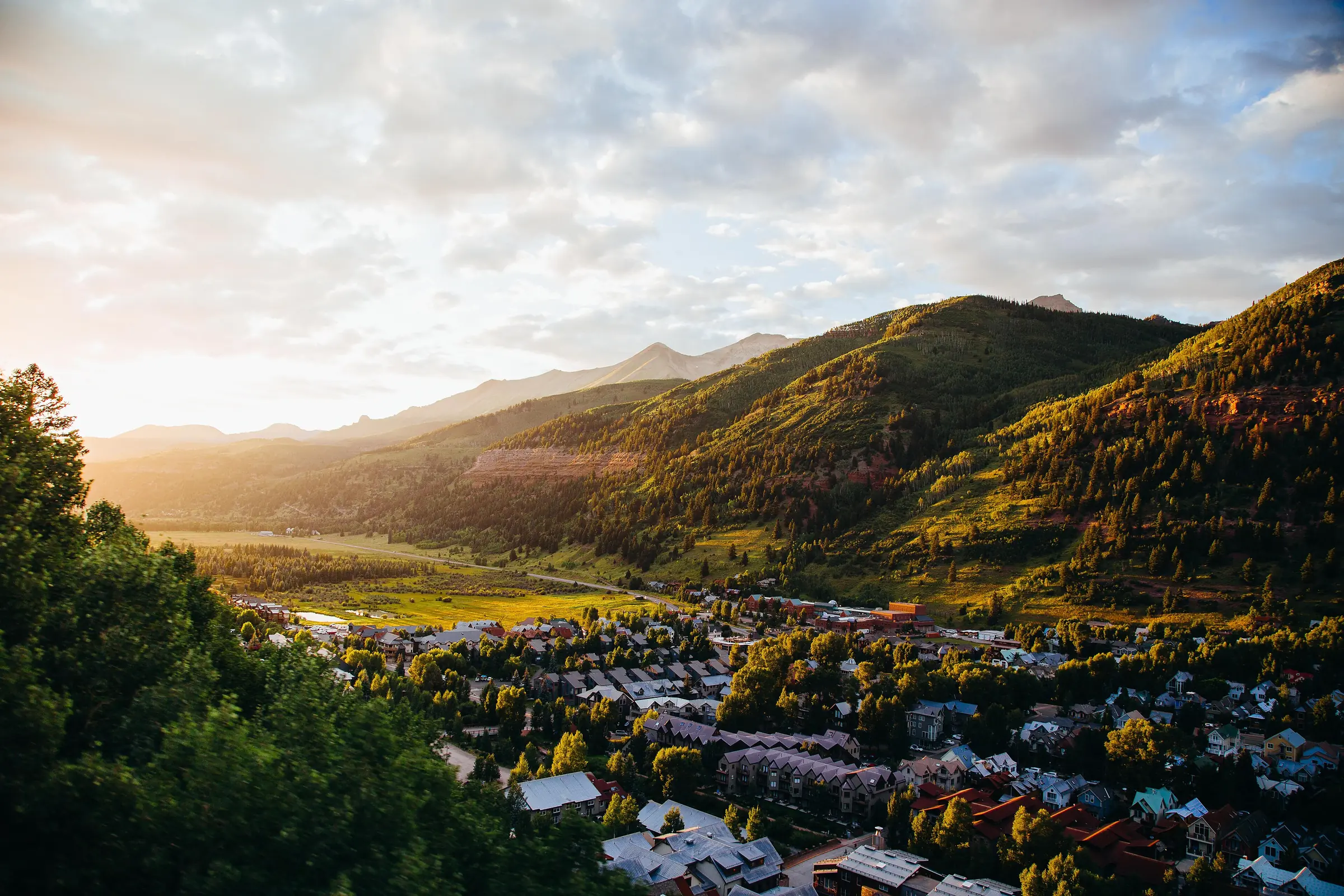
Telluride sits in a box canyon, and the ridge to the south blocks the low winter sun for part of town.
The horizon is the angle of the skyline above flat ground, seen from your roof. In the terrain model of PVGIS, the European Commission's free solar calculator, the horizon due south of the town centre rises to 25.6°, and at a point near the south side of town to 30.9°. The noon sun on the winter solstice climbs only to 28.6°. At that south-side point, the model has the ridge hiding the sun at solar noon around the solstice.
| South plane, 45° (Modelled, PVGIS) | December kWh per kW |
|---|---|
| Town centre, horizon ignored | 147 |
| Town centre, horizon applied | 99 |
| North side of town, horizon applied | 123 |
| Point near the south side, horizon applied | 35 |
Over a full year the horizon costs the town-centre plane much less: about 1,979 kWh per kW without it, 1,823 with it. (This run uses 2005–2023 weather, so it differs slightly from the 1,839 in the plane table.) These are model figures: the terrain grid is about 90 m and ignores trees and buildings.
Why this matters for a quote: SMPA asks for a PVWatts or similar estimate with its first application step, and a plain PVWatts run does not see the canyon unless the installer adds a shade loss or horizon data. A quote built that way can overstate your winter output, worst of all on the south side of town. Ask for a horizon-adjusted estimate with monthly figures for each plane, or an on-site shade measurement. Then compare December and January across quotes, not just the yearly total.
Worked example: west now, east later
Illustrative example. A two-story 1890s house on a Telluride residential street. The gable ridge runs away from the street, so the side planes face west and east. The street-facing gable end is the primary façade, so no panels go there. The household uses enough power in both periods to absorb the output.
Phase 1 (now) Phase 2 (trigger: budget, or a hot tub, snowmelt or EV that adds evening load) Plane West side plane, flush, all-black non-reflective frames East side plane Size 4.0 kW DC 3.0 kW DC (7.0 kW total, under SMPA's 10 kW limit) Yearly output (Modelled, horizon applied) about 5,130 kWh, about 1,500 of it 4–9 p.m. about 4,260 kWh, about 140 of it 4–9 p.m. Bill value, current rates (Illustrative calculation) about $775 a year about $490 a year Bill value, proposed rates (Illustrative calculation) about $875 a year about $510 a year Reviews HARC (level to confirm), Town building and electrical permit, SMPA Steps 1–3, $300 rebate New HARC review, new permit, new SMPA Step 1; second rebate to ask about The same 4.0 kW on a south plane would be worth about $905 a year now or $970 at proposed rates, if HARC allowed it. The west plane gives up about 15% of the value, not 30%, because more of its output lands in the on-peak bank.
Two checks tell you whether the example fits your house.
On-peak test for phase 1. Phase 1 makes about 1,500 kWh a year between 4 and 9 p.m., roughly 125 kWh a month (Illustrative calculation). Export 12 months from SMPA's SmartHub portal and look at your on-peak kWh. If your evenings use less, the extra credits sit in the on-peak bank and the west advantage shrinks.
Off-peak test for phase 2. The east plane adds about 4,120 off-peak kWh a year to phase 1's 3,630 (Illustrative calculation). If your yearly off-peak use is below that total, part of phase 2 ends up paid at SMPA's avoided cost at true-up instead of offsetting retail power. Tie phase 2 to a real trigger, not a date.
How "start small, add later" would work in Telluride
Proposed service. Solar Today and Tomorrow is a proposed service for mountain homes: a first phase that fits today's budget and the utility's limit, built so phase 2 is cheap to add. Coverage of Telluride is proposed and not yet confirmed. The home page explains the phased method in full. In Telluride, the written deliverables would be:
- Phase map (Proposed service). A street-view sketch as well as a roof plan, because HARC judges what the public sees. Phase 1 drawn solid on the plane most likely to pass, phase 2 dashed, the primary façade marked as excluded.
- Horizon-adjusted estimate (Proposed service). Monthly kWh per plane with the canyon horizon applied and the on-peak share shown.
- Cap sheet (Proposed service). Both phases against SMPA's 10 kW limit, each split between the two banks.
- Snow sheet (Proposed service). Where each phase sheds, the side setback on that side, any guards, and racking rated against the Town's design criteria.
- Readiness items on their own lines (Proposed service). Conduit and breaker space for phase 2, and an inverter that can grow: panel-level electronics, or a string inverter with spare input capacity.
- Phase 2 paperwork (Proposed service). New HARC review, new Town permit, new SMPA Step 1, and the rebate question.
The site assessment would take about two hours (Illustrative example). You'd bring 12 months of SmartHub usage split by period, and a photo of each roof plane taken from the street, since that is the view HARC weighs.
One Telluride rule belongs in the phase 2 trigger. The Town's Energy Mitigation Program (TEMP) requires snowmelt, pools, hot tubs, spas and heated garages to offset their energy with an on-site or eligible off-site renewable system, or pay a fee in lieu, and it allows partial on-site mitigation. If phase 2 is "when we add the hot tub," ask the Building Official whether the added panels would count toward that obligation and at what value. The program sits on the Town's Energy Codes page; current fee values were not confirmed for this page.
HARC first, then the Town, then SMPA
File in this order. Each office needs what the one before it approved.
- HARC application. Exterior changes go through Telluride Historic Preservation, filed on SmartGov. The HARC and planning applications page says to attach the HARC Application Checklist to "a HARC Development Application of any scale"; incomplete applications are not reviewed. The guidelines set four review levels: insubstantial (staff), minor (HARC chair), small-scale (full commission) and large-scale (preliminary and final reviews). Which level a rooftop array gets was not confirmed. Ask staff before filing, because the answer decides whether you wait for a commission meeting.
- Town building and electrical permits. The Building Division takes permits through the SmartGov portal only; paper is no longer accepted. The Building Codes page says the 2024 International Codes took effect September 12, 2025, and the "Town of Telluride administers Electrical and Plumbing Permits on SmartGov." The array's electrical permit and inspection run through the Town.
- SMPA Step 1. Your contractor starts the application with a PVWatts or similar estimate. SMPA says this "may take a few weeks" because its engineers model every proposed system.
- Install and Town electrical inspection. SMPA's policy requires the local inspection.
- SMPA Step 2. The contractor sends an as-built one-line drawing, a single-line diagram of the system as installed.
- SMPA Step 3. You sign. SMPA allows no operation before Step 3 approval, and credits start that day. That approval is your permission to operate (PTO).
Phase 2 repeats the list. The guidelines note that work which "changes the physical appearance of the building" may need HARC approval even where maintenance doesn't, and new panels change the appearance. Ask at the phase 1 HARC review whether the commission will look at the phase 2 plane at the same time; the answer wasn't found in the Town's published material.
SMPA's rules: two banks, 10 kW and a yearly true-up
SMPA, the electric co-op for San Miguel County, lists Telluride in its service area. Its net metering policy (Policy 303), revised January 2022 and still the version SMPA links, sets the limits a phased plan must fit:
- 10 kW for residential net metering. Net metering credits each kWh you send out against one you use later. Between 10 and 100 kW you move to a split system with a second meter and its own access charge, or to net billing. Keep both phases at or under 10 kW.
- Monthly excess carries forward one for one in its bank.
- Annual true-up on April 1 or November 1. Unused credits are paid at SMPA's avoided cost within 60 days. That rate wasn't published on the pages checked, so ask for it.
- $300,000 liability insurance for systems up to 25 kW. Ask your insurer whether your policy meets it before Step 3.
- Renewable energy credits go to SMPA, so you can't sell the system's clean-energy certificates.
The true-up date matters more in the canyon than on open ground. A November 1 true-up pays out summer surplus just before the months when the horizon cuts output hardest; an April 1 true-up lets that surplus carry through the winter. Ask SMPA which date applies to your account before you size phase 1.
SMPA's renewable rebates page lists $0.10 per watt, up to 3 kW or $300, filed by the contractor, with deadlines. A 4.0 kW phase 1 reaches the cap. Whether phase 2 earns a second rebate isn't stated; ask before counting on it.
Rates are moving. SMPA's 2027 proposed rates, dated October 29, 2026, would take effect December 15, 2026: TOU access from $33 to $42 a month, on-peak from $0.25 to $0.31, off-peak from $0.11 to $0.113. Until adopted, the higher column in the plane table is a scenario. Plane values on this page use the default TOU rate, not the optional single-bank TOD Peak Power rate.
Mountain Village shares SMPA and its 10 kW limit but has its own design review and permit route, so its paperwork differs from the HARC route above.
Snow: where each phase sheds
On a side plane, snow sliding off the array heads for the side yard and, where the setback is tight, toward the neighbor's lot.
The Building Codes page prints Telluride's design criteria as "Wind 70, Snow Load 75, Exposure B," without units. Ask the Building Official what units "Snow Load 75" uses and whether it is a ground or roof load, then have the installer show racking and attachment ratings against it in writing.
HR Policy 28 in the Design Guidelines says buildings "with metal-clad roofs and side yard setbacks of less than 5 feet shall have snow guards, brakes or other devices to prevent snow and ice shedding onto adjacent properties," and asks that decks and walkways sit away from shedding. Snow guards are brackets or bars that hold snow on the roof so it melts or falls in small amounts. The rule is written for metal roofs; whether the Town applies it to an array is a question to ask. If the setback on a phase's side is under 5 feet, plan for guards.
The snow sheet should show, per phase:
- the shedding zone on a site plan, with doors, decks, walkways, the meter and vents marked;
- the side setback on that side, measured;
- the guards and how they attach;
- the racking rating against the Town's criteria.
Phase 2 on the opposite plane adds a second shedding zone toward the other neighbor. Draw both now, so phase 1's guards and walkways don't have to be moved later.
Check the price per watt, and what no longer applies
Divide the solar-only price by the system's size in watts. Price per watt ($/W) lets you compare quotes of different sizes. Take out readiness items, snow retention and roof work first, or a phased quote will look dearer than it is.
Illustrative calculation. A phase 1 quote of $15,200 for 4.0 kW DC is $3.80/W. Remove the readiness items ($800) and snow retention ($600): $13,800, or $3.45/W, about 14% above EcoGen's Colorado State benchmark of $3.02 per watt (September 2026 Edition, prices as of September 25, 2026). Then subtract the $300 SMPA rebate from what you'd pay.
The benchmark is statewide. EcoGen's methodology describes it as a modelled installed price per watt for a representative home system, cash, before incentives. A higher Telluride quote isn't automatically wrong. Ask the installer to name what explains the gap: a steep historic roof, HARC drawings, laminated panels, or travel into the canyon.
Ask for Town fees on their own lines too. The building permit fee schedule (effective January 1, 2023) bases the permit fee on project value and adds plan check at 65% of that fee, a 20% Green Building Fee, and Town and County use tax. Whether solar is exempt from the local use tax wasn't confirmed; ask the Building Division.
Three claims in the search results for this query don't apply to a Telluride home:
- The 30% federal tax credit. The IRS says the Residential Clean Energy Credit "is not available for any property placed in service after December 31, 2025."
- A "200% cap" and credits that "roll over indefinitely." A statewide guide in these results describes those rules; SMPA's are the 10 kW limit and an annual true-up at avoided cost.
- "300 days of sunshine." It says nothing about the ridge south of your roof, which the December figures above show can matter more.
Telluride quote checklist
Bring this to every quote alongside the quote checklist on this site. Get more than one bid.
- Placement. Which plane is phase 1 and why it should pass HARC: not the primary façade, flush, below the ridge, non-reflective. Shown on a street-view sketch.
- Review level. What Historic Preservation staff said: staff, chair or commission.
- Who files what. HARC with the checklist, Town building and electrical permits, SMPA Steps 1–3, each with a named filer.
- Horizon-adjusted estimate. Monthly kWh per plane with the canyon horizon, or an on-site shade measurement, plus the 4–9 p.m. share.
- Cap sheet. Both phases at or under 10 kW, split by bank, with your true-up date noted.
- Snow sheet. Shedding zones, setbacks under or over 5 feet, guards, racking against "Snow Load 75" with units confirmed.
- Readiness items. Conduit, breaker space and inverter capacity for phase 2, each priced.
- Solar-only $/W after readiness, snow and roof items come out.
- Town fees and use tax, shown separately or marked excluded.
- Rebate and insurance. Who files the $300 rebate, the phase 2 rebate answer, and the $300,000 liability cover.
- As-built one-line drawing after Step 2.
- Warranties in writing for panels, inverter and workmanship, with no expired federal credit in any savings figure.
Short answers
Does Colorado have a tax credit for solar panels?
The credit most people mean is the federal Residential Clean Energy Credit, which ended for systems placed in service after December 31, 2025. The incentive confirmed for a Telluride home on this page is SMPA's rebate, up to $300. Check state tax treatment with a tax adviser.
Can I add panels later?
Yes, if phase 1 is built for it. Stay at or under 10 kW and expect a new HARC review, permit and SMPA Step 1.
Should I plan with SMPA's current or proposed rates?
Plan with both. You pay the current rates until SMPA adopts the 2027 schedule. The proposed column shows the evening bank gaining value, which moves a west plane from about 85% to about 90% of a south plane's worth. The proposal may change before adoption.
Where does a battery fit?
In the proposed service, a battery is one possible later phase, priced separately. This page doesn't size one; ask SMPA how it would treat a battery under your agreement before you buy.