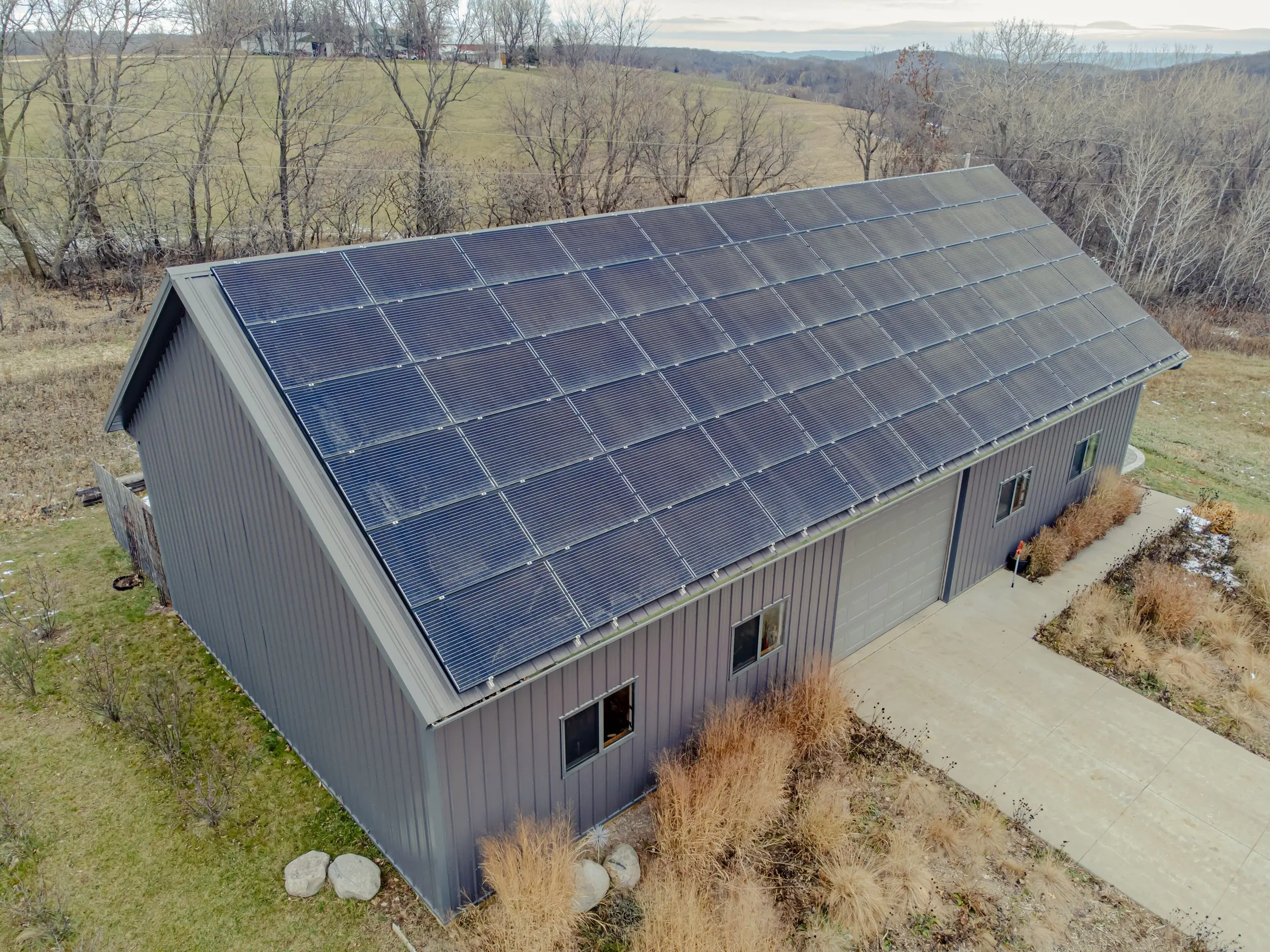
On Empire Electric, oversizing is the costly mistake
Empire Electric Association (EEA) caps a home system twice: at 10 kW AC, and at production of no more than 120% of your average annual use. Surplus left at the April 30 true-up is paid at EEA's average wholesale price, which EEA lists as $0.03619 per kWh (November 2026). A kWh you use at home offsets roughly 11.5¢ on the 2026 residential rate. So in Mancos the expensive mistake is building too big, not too small.
Check who sends your bill before anything else. Mancos sits near the eastern edge of EEA's territory, and homes east of town, toward Mancos Hill or Hesperus, may be on La Plata Electric Association (LPEA) instead. If your bill says LPEA, you're on a different co-op with a different size rule, and the numbers below don't apply.
The reverse case catches people too. The two installers in Google's local results for Mancos that we could check in November 2026 are based in Durango, which is LPEA country. LPEA allows production up to 150% of past use; a system sized to that rule would break EEA's limit. Whoever you talk to, ask them to write EEA's 120% figure on the cap sheet.
A few terms first. A kilowatt (kW) is a system's size; a kilowatt-hour (kWh) is energy over time, the number EEA bills you for. Panels are rated in kW DC (direct current). The inverter turns that into kW AC (alternating current), the power your house uses. EEA's 10 kW cap is written in AC, so the inverter's AC rating is the number to check.
The rules that shape a phased build come from EEA's Policy 56 on interconnecting home generation and its net metering tariff:
| EEA rule | What it says | What it means for your phases |
|---|---|---|
| Power limit | Residential net metering up to 10 kW AC; larger systems case by case | Keep both phases together at or under 10 kW AC |
| Energy limit | Production no more than 120% of average annual use | Your 12-month history sets the ceiling for both phases |
| Monthly billing | Net billing each month; grid access and demand charges still apply | Solar reduces the kWh line, not the fixed charge |
| Year-end surplus | True-up on April 30, paid within 60 days at the prior 12 months' average wholesale cost; or a one-time election to roll credit over indefinitely, with no payout when service ends | Either way, surplus is worth far less than self-use |
| Adding capacity | EEA approval and an amendment to the interconnection agreement first | Phase 2 starts with EEA, not with panels |
| Fees | $200 application; $60 re-application | Ask which one phase 2 triggers |
Net metering means the kWh you send to the grid are credited against the kWh you take. EEA's net meter FAQ says the 120% allowance exists "to allow for variations caused by weather" and that net metering "is not designed for a member to make money by selling power". Take EEA at its word. The 120% is headroom for a cloudy year, not a target.
Cap sheet: phase 1 now, phase 2 when the bill rises
A cap sheet turns your usage into EEA's ceiling and shows where each phase sits under it. It starts from a production factor: the yearly kWh one kW of panels makes at a given place. EcoGen's Colorado figure is 1,656 kWh per kW per year, from a Denver reference location. At about 7,020 feet, with snow cover and low December sun, a Mancos roof may produce more or less, so ask for a site-specific PVWatts estimate. The method stays the same.
Illustrative example. A Mancos home used 9,000 kWh in the last 12 months (assumed figure, read from a SmartHub export). State production factor: 1,656 kWh per kW per year.
- EEA's ceiling today: 120% × 9,000 = 10,800 kWh a year. 10,800 ÷ 1,656 = 6.52 kW DC. The 10 kW AC limit doesn't bind yet.
- Size that matches use: 9,000 ÷ 1,656 = 5.43 kW DC.
- Phase 1: 4.4 kW DC, producing about 4.4 × 1,656 = 7,286 kWh a year, about 81% of use.
- Room left today: 6.52 − 4.4 = about 2.1 kW DC under the ceiling, but only 5.43 − 4.4 = about 1.0 kW DC of it would be used in the house.
- Phase 2 trigger: use rises to 12,000 kWh a year and shows in 12 months of bills (assumed figure, for example after adding electric heat). The ceiling becomes 120% × 12,000 = 14,400 kWh, or 14,400 ÷ 1,656 = 8.70 kW DC. The size that matches the new use is 12,000 ÷ 1,656 = 7.25 kW DC, so phase 2 would be about 2.85 kW DC. The other 1.45 kW the ceiling allows stays unused, as weather headroom.
- AC check: 7.25 kW DC in total, on an inverter rated 10 kW AC or less. Confirm the AC rating on the inverter's spec sheet.
Why not fill the 6.52 kW ceiling on day one, while a crew is already on the roof? Run the slice above your use through EEA's true-up price.
Illustrative calculation. Building 6.52 kW instead of 5.43 kW adds about 1.09 kW. That slice makes about 1.09 × 1,656 = 1,800 kWh a year, all of it surplus. At EEA's current true-up price of $0.03619 per kWh, it earns about $65 a year. At the $3.02 per watt Colorado state benchmark, it costs about 1,087 W × $3.02 = $3,283. Simple payback on that slice: about 50 years.
An add-on slice usually costs less per watt than a whole system. Even at half the benchmark, about $1,640, the payback is still about 25 years.
Used inside the house, the same kWh would offset about 11.5¢ on EEA's 2026 residential rate, roughly three times the true-up price. That gap is the case for phasing in Mancos: buy what you'll use now, and add more when the bill proves you need it.
One question is open. EEA measures the ceiling against "average annual energy usage", and we couldn't find whether it counts a newly bought load, such as a heat pump, before it shows in your history. Ask EEA in writing. Until it says yes, the safe trigger is higher use already on your bill.
Get phase 2 approved before you add a panel
Under Policy 56, a member must notify EEA and start an amendment to the interconnection agreement "before any interconnected resource is modified, replaced, or increased in capacity". EEA may then amend the agreement, ask for a new application, or require you to pay for system improvements first.
EEA's Interconnection Standards, Revision 9 (October 9, 2026) set the steps: application and fee, a receipt notice within 3 business days, a completeness review within 10 business days, an engineering study if EEA wants one, inspection by the permitting authority, then EEA's inspection and witness test before switch-on. Systems between 10 and 25 kW need extra equipment (surge arrestors and protective relaying), and a residential system above 10 kW may need approval from EEA's Board of Directors. Keeping both phases together at 10 kW or less keeps you in the simplest class.
A cheap phase 2 depends on choices made in phase 1:
- Conduit (the pipe that carries the wiring) sized for phase 2's conductors.
- Rail into the phase 2 area, or a layout that keeps the right roof plane free.
- Breaker space in the main panel, and a busbar rating that can take the added solar.
- Inverter route. Module-level electronics, which make it easier to add panels in small steps, or a string inverter with a spare input.
Proposed service. Solar Today and Tomorrow's coverage of Mancos is proposed, not confirmed; this page describes how the service would work here. For a Mancos home, the proposed service would:
- Start from your SmartHub 12-month export and your EEA rate schedule.
- Write a cap sheet against EEA's two limits (120% and 10 kW AC).
- Draw a phase map: phase 1 solid, phase 2 dashed, with the conduit route and inverter location.
- Price readiness items and snow guards on their own lines, so you can see and drop them.
- State who files the $200 EEA application now and the amendment later, and add a snow sheet (below).
The phase 2 trigger would be written down too: your budget, or higher use showing on your bill, not a forecast. See the full proposed service for the assessment and every deliverable.
Who permits your system: in town or out
A Mancos mailing address can sit inside Town of Mancos limits or in unincorporated Montezuma County. The permit route and the structural check change at the town line, so find out which side you're on first.
Inside town limits
The Town of Mancos Building Department handles planning, zoning, building inspections and code enforcement in one office, and offers a pre-application conference with the Community and Economic Development Director. Use it to settle the questions below. The Town doesn't inspect electrical work; the state does, and your contractor obtains the permits.
The Town's Land Use Code (Mancos municipal code, Chapter 16) sets solar rules that shape both phases:
- Size. A small solar energy system may send the grid no more than 120% of the home's total annual on-site use. The figure matches EEA's, but the Town counts energy exported, while EEA counts total production. EEA's rule is the tighter one, so a design that passes EEA should pass the Town on size. Ask which figure the Building Department checks.
- Roof mounts. As flush to the roof as practicable, not above the ridgeline of a pitched roof, and not beyond the building's exterior perimeter.
- Ground mounts. No more than 15 feet above average unaltered grade, with exterior lines buried.
- Location. No glare onto neighbors or roads. One section bars systems from side and rear setbacks; a table lets small collectors into a side yard. Plan ground mounts outside all setbacks and confirm at the pre-application conference.
- Filings. Submit a map to the Town and to emergency service providers showing where the panels and the panel disconnect are. For a grid-tied system, give the Town written approval from the utility.
- Removal. A system that stops working for 12 months must be removed within 90 days.
The filings matter for a phased build. Ask whether the disconnect map and the utility approval must be updated when phase 2 goes in. A small system is listed as a permitted use, so a normal home system shouldn't need a Planning & Zoning hearing; confirm that for your district.
Historic properties. If your house is on the Town Register of Historic Properties, you must consult the Historic Preservation Board before any alteration. Its recommendations are non-binding, but the consultation is required. We couldn't find a list of designated properties, so ask at the pre-application conference.
County parcels outside town
Montezuma County's building guidance says it has no building department and does not enforce building codes for residential construction. You may hire a qualified inspector. For snow loads, wind loads and foundations, the County says to contact an engineer.
So on a county parcel, no local office checks whether the roof and racking can carry the array plus the snow. That falls to the installer and an engineer you hire. If a county quote has no structural check, ask who signs off on the roof.
Subdivision covenants can be stricter than County rules, so read yours. The County sets auxiliary structures 30 feet back from county road rights-of-way and property lines; ask the County whether a ground-mount frame counts.
Either way
Every grid-tied system needs a state electrical permit through the Colorado Division of Professions and Occupations (electrical and plumbing permits). Your contractor obtains it, and an adult homeowner or representative must be present at inspection. Expect phase 2 to need its own permit and inspection.
Check the floodplain before choosing a ground mount or a low spot for the inverter or disconnect. In town, the Building Department lists a Floodplain Map and a Floodplain Development Permit, and on November 12, 2026 the Town posted a resolution declaring a local disaster emergency due to flooding. In the county, floodplain parcels need proof of compliance with Floodplain Resolution 13-2008.
Snow at 7,020 feet: who supplies the design load
Snow and cold are design inputs at Mancos's elevation, and who supplies the snow number depends on the same town line. In town, the Building Department posts a technical-assistance sheet for building permits; we couldn't open it, so ask the department for its adopted design snow load. On a county parcel, the County sends you to an engineer, and no one checks the result. This page prints no snow-load figure for that reason.
Whichever side you're on, the proposed service would deliver a snow sheet with:
- Design snow load, with its source: the Town's adopted value for an in-town home, or an engineer's figure for a county parcel.
- Racking rating, set against that design load.
- Shedding zones. Snow tends to slide off panels in sheets; the sheet marks where it lands (doors, decks, walkways, vents, meters).
- Snow guards where a landing zone matters: brackets that hold snow on the roof so it melts or drops gradually.
- Cold-morning string voltage. Panels wired in series form a string, and its voltage rises as the temperature drops. Ask which record-low temperature the designer used to check that the string stays within the inverter's limit.
- Winter shade from a ridge or tree at low December sun, and access for clearing, with who does it.
In town, roof panels must sit as flush as practicable and inside the building's perimeter, so snow leaves the array where the roof would shed it anyway. Plan the guards with the layout, not after. A ground mount is worth a look only where snow or the roof argues for one, such as a roof that dumps snow onto the only entrance. In town it must stay under 15 feet, outside setbacks, with buried lines; out of town, settle the engineer and the County setback question first.
Check the price, then check the size against your bill
Price per watt ($/W) is the quoted price divided by the system's rated watts, the quickest way to compare quotes of different sizes. Take out everything that isn't the solar system before you divide.
Illustrative example. A phase 1 quote of $14,500 for 4.4 kW DC: $14,500 ÷ 4,400 W = $3.30/W.
Remove items a solar-only benchmark doesn't price: phase 2 readiness (upsized conduit, spare rail, breaker space; assumed $900) and snow guards (assumed $600). $14,500 − $1,500 = $13,000. $13,000 ÷ 4,400 W = $2.95/W.
State benchmark: EcoGen's Colorado solar cost benchmark is $3.02/W (September 2026 Edition, prices as of September 25, 2026; cash, solar only, before incentives).
All in, the quote looks 9% high. Solar only, it sits just under the state figure. The readiness lines are real costs, but they buy phase 2, so keep them separate.
EcoGen's solar database adds a rule: don't compare a solar-only cash benchmark with a battery-inclusive or financed quote without accounting for the difference. Strip out any battery, roof work or panel upgrade too.
Then check the size, which on EEA matters as much as the price. Divide the quote's first-year production estimate by your SmartHub 12-month total:
| Result | What it means on EEA |
|---|---|
| Under 100% | Every kWh is used at home or banked against your own use; room is left for phase 2 |
| 100% to 120% | The share above 100% is paid at the true-up price, about 3.6¢ per kWh in November 2026 |
| Over 120% | Above EEA's residential net metering limit; the quote needs resizing before EEA will approve it |
Three corrections to what you may read elsewhere:
- The federal credit is gone. The IRS says the residential clean energy credit is not available for property placed in service after December 31, 2025. Prices quoted "after federal tax breaks" assume a credit you can't claim.
- Front Range incentive lists don't apply. Incentives built around Xcel and other Front Range utilities don't cover an Empire Electric member. EcoGen's Colorado paybacks are modeled for Xcel, Black Hills, CORE and Colorado Springs Utilities, not Empire, so use its $/W benchmark and skip its paybacks.
- Fixed charges are rising. EEA's 2026 residential rate is a $45.00 monthly grid access charge plus $0.09452 per kWh and a $0.02026 power cost adjustment. From January 1, 2027, a 4.72% revenue increase goes into grid access and demand charges: the residential grid access charge becomes $50.65 a month, energy $0.11677 per kWh, with the adjustment reset. Solar doesn't offset the grid access charge.
We don't print a whole-system payback for Mancos: it depends on your use, your roof and EEA's 2027 adjustment, which we haven't seen. Ask any installer for the inputs behind theirs.
Mancos quote checklist
Use this with any Mancos-area quote, including one from this service. The quote checklist on this site follows the same order.
Bring
- Your 12-month usage export from EEA's SmartHub portal, in kWh by month.
- Your rate schedule, and the true-up option you'll choose: April 30 payout at wholesale, or indefinite roll-over.
- Whether your parcel is inside Town of Mancos limits or in unincorporated Montezuma County.
- Your floodplain status (Town floodplain map, or County Resolution 13-2008).
- Whether the house is on the Town Register of Historic Properties.
- A photo of your main electrical panel, door open.
Get back in writing
- A cap sheet (12-month use, 120% of it in kWh and kW DC, both phase sizes, the inverter's AC rating against 10 kW AC) built on EEA's rule, not LPEA's 150%, and a phase map.
- The first-year production estimate as a share of your 12-month use.
- The phase 2 trigger, and what EEA said about counting new loads.
- Who files the $200 EEA application and the phase 2 paperwork, and whether EEA treats phase 2 as an amendment, a new application or a $60 re-application.
- In town: who files the building permit, the disconnect map and the written utility approval. On a county parcel: who checks the structure, and whether an engineer's letter is included.
- Who holds the electrical contractor registration and pulls the state electrical permit for each phase.
- The snow sheet described above.
- Readiness items and snow guards on their own lines, and the solar-only $/W.
- Monitoring access in your name.
That last item matters on EEA. Once net metering starts, EEA's SmartHub can only show the kWh it delivered and received, not your total use. Production data has to come from the system's own monitoring, and without it you can't check phase 1 against the quote before paying for phase 2.
Questions Mancos homeowners ask
Does Colorado have a solar tax credit in 2026? The federal residential credit ended for systems placed in service after December 31, 2025. This page doesn't cover state tax items; ask a tax adviser before you count on one.
Can I add panels later? Yes, with EEA's approval first. EEA's own list of questions for solar contractors includes this one. The answer depends on the 120% ceiling, the 10 kW AC limit and an amendment to your interconnection agreement before any new panel is connected.
Can I install it myself? EEA's FAQ says members may self-install, but the application and the state electrical inspection still apply.
Will solar keep my power on in an outage? Not without a battery, per EEA's FAQ. A battery can be a later phase on its own quote.
Does EEA recommend installers? No. EEA says it does not recommend or endorse third-party contractors.